
Europe for research

National Rectors’ Conferences call for stronger human rights safeguards in FP10
As National Rectors’ Conferences of Austria, Belgium (VLIR, CRef), France, the Netherlands, Poland and Spain we jointly call for stronger safeguards on human rights in the next EU Framework Programme for Research and Innovation (FP10, 2028–2034).
Current state of play
The European Union is founded on the indivisible and universal values of human dignity, freedom, equality and solidarity, as laid down in the Charter of Fundamental Rights of the European Union. These values guide the Union’s commitment to democracy, the rule of law, and the protection of individual rights.
In its Communication on the Global Approach to Research and Innovation, the European Commission reaffirmed its commitment to maintaining open international cooperation in research and innovation, while ensuring a level playing field and reciprocity grounded in fundamental values. Strengthening human rights safeguards in FP10 would give practical effect to these commitments.
In Horizon Europe (2021–2027), beneficiaries are required to respect ethical principles and applicable law. Article 19 of the FP9 Regulation states that: “Actions carried out under the Programme shall comply with ethical principles and relevant Union, national and international law, including the Charter and the European Convention for the Protection of Human Rights and Fundamental Freedoms and its Supplementary Protocols.” One should note that this provision primarily concerns the conduct of specific research actions, rather than the eligibility of beneficiaries themselves.
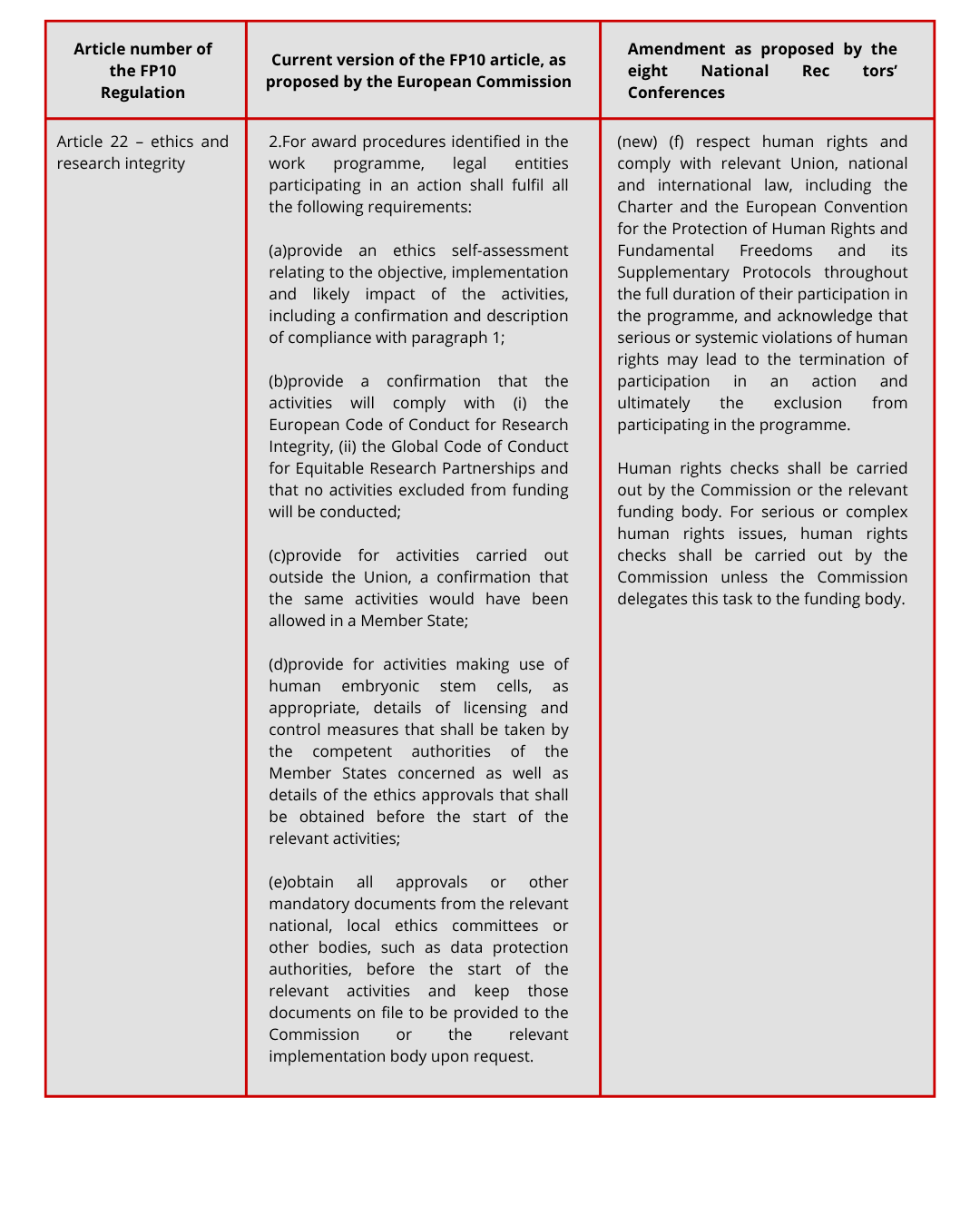
The European Commission’s initial proposal for FP10 maintains a similar framework in Article 22 (Ethics and research integrity).
The need for stronger safeguards
As National Rectors’ Conferences of Austria, Belgium (VLIR and CRef), France, the Netherlands, Poland and Spain we jointly call for stronger safeguards on human rights in the next EU Framework Programme for Research and Innovation (FP10, 2028–2034).
We therefore call on the European Institutions to amend the proposed FP10 Regulation so that respect for human rights – referred to in EU terminology as fundamental rights – becomes an explicit requirement for participation in the programme. Where beneficiaries are found to be involved in serious or systemic violations of human rights, this should lead to termination of participation in funded actions and possible exclusion from the programme.
Proposed amendment for FP10
To ensure that respect for human rights applies to beneficiaries throughout their participation in the programme, we propose adding the following amendment 22(2)(f):
Why this amendment matters
The proposed amendment primarily establishes a clear responsibility for the European Commission.
Under this system the European Commission (or the relevant funding body) would conduct human rights checks on beneficiaries, based on transparent criteria and independent expert assessment. In cases involving serious ethical concerns or systemic violations, entities could be excluded from participation in the Framework Programme.
Comparable exclusion mechanisms already exist in EU programmes in cases involving fraud or financial misconduct.
Importantly, the proposal does not restrict universities’ autonomy. Institutions would remain free to assess potential collaborations independently and apply their own institutional policies in addition to any exclusions decided at EU level.
